|
|||||||||||||
| Today is May 16, 2008 | |||||||||||||
|
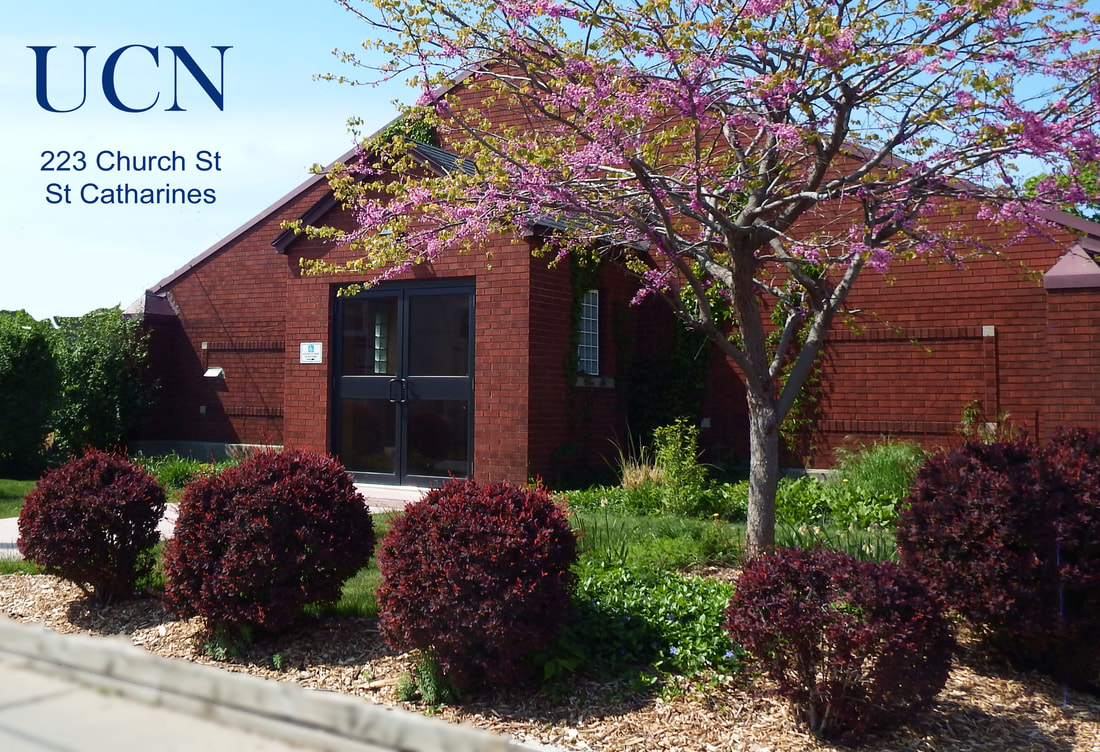
WELCOME . . . The Unitarian Congregation of Niagara is located at 223 Church Street, St. Catharines, Ontario, Canada. We covenant to support an empowering church that affirms the individual and celebrates history, science, and mystery in a welcoming, joyous, and evolving fellowship. Press MAP for directions to our church.
We are in our 52nd year in St. Catharines. The best way to characterize our denomination these days is that it is a church without a creedal requirement. This means that we welcome a diversity of approaches toward the formulation of answers to the large questions concerning the meaning of life, the nature of reality, the sacred, transcendence, and death. We believe that it is our duty, as well as our privilege, to form a loving community, not because we happen to believe the same things, but exactly because we respect one another in our individuality and diversity. We do not think that the institution of the church is the repository of final answers to our questions; it is, rather, a fellowship of seekers, who enjoy sharing their respective individual journeys toward deepening our understanding and insights, as well as refining our feeling responses to the beauty, mystery, and challenges of life. We value human beings, and, indeed, all life; we believe in the interconnectedness of all aspects of reality; we value reason and reflection; we believe in the democratic process, in the importance of love, compassion and generosity and in the possibility of development, maturation, and deepening individually, culturally, and globally. Historically the present denomination is about 40 years old, when two separate denominations, the Unitarians and the Universalists merged. The Unitarian tradition is the older one, reaching back to the beginnings of the Reformation. One of its founders, a Spaniard named Michael Servetus was burned at the stake for heresy in Calvin's Geneva. Like other Protestants, the early Unitarians believed that the Roman Catholic way of Christianity had strayed from the intention of its founders, and wished to restore it to its original purity. They deemed that the break from soundness began when Constantine the Great adopted Christianity, and wished to formulate its doctrines. Thus, there were councils at which various notions about God, Jesus, and humanity were debated, and the victorious ones were declared "sound" and "orthodox", while their rivals were considered heretical and condemned. The early Unitarians considered this to be unsound. They rejected the dogmatic formulations of the creeds, and expressed their confidence in the ways of conscience and reason. They emphasized the unity of God, and trusted the consequences of the serious study of Scriptures and the scrutiny of rational reflection. The faith had a large and early following in Transylvania and Poland, and though it was extinguiushed and persecuted in Poland, it survives to our days in Transylvania. In Eastern Europe, it remained as it was originally, a Protestant Christian denomination. In Western Europe, and subsequently in North America, the Enlightenment affected Unitarianism, and especially because of the influence of Ralph Waldo Emerson, a Unitarian clergyman, who was an influential literary figure and who was attracted to Vedic spirituality, Unitarianism became more open to non-Christian forms of spirituality. The Unitarians contributed to the Congress of World Religions held in Chicago, to which such spiritual leaders as Swami Vivekananda, a Hindu follower of Sri Ramakrishna, and Abdu'l-Baha, a leader of the Baha'i faith, were welcomed. Unitarians also became more open to secular and humanist modes of thinking, affirming the compatibility of science and religion. Many came to believe that a religious attitude must be exercised toward temporal and social issues of justice, exploitation, poverty and human rights - not simply as a means for a preferable afterlife, but because the here-and-now is of value, and is the arena in which the fruits of a liberal religious attitude will bring about transformation and betterment.
The Universalists, in contrast, developed in America. They differed from their fellow Protestants in rejecting the notion of hell-fire and damnation, seeing these as incompatible with a just, loving and merciful God. Although early Church fathers like Origen already expressed such a view, it was not accepted by the Church, and did not become the characterizing feature of a denomination until the 18th century. While Unitarians in America were usually from educated urban classes, the early Universalists were mostly rural less wealthy. By the middle of the 20th century, the two groups were sufficiently similar that their leadership decided to pool their respective resources, and form a single new denomination, called Unitarian-Universalist. Although many individual congregations retained an awareness of their roots as either Unitarian or Universalist, the merger was successful. More recently a distinctively Canadian administrative body, the Canadian Unitarian Council, has taken over all administrative responsibilities for Canadian congregations from the previously continent-wide organization, known as the Unitarian-Universalist Association, whose seat is in Boston, Massachusetts.
|
||||||||||||
|
Unitarian Congregation of Niagara Site design by International Internet Consultants |
|||||||||||||